The 4iAI™ Open Standard
A universal open standard for human-AI peer-to-peer symbiotic resonance and artistic integrity. Explore the Possible · Reject the Passable · Verify the Plausible · Produce the Profound via the 4iAI™ collaborative circuit · I. Inspiration (Human Catalyst) · II. Insight (Synthetic Mirror) · III. Introspection (Human Depth) · IV. Innovation (Symbiotic Resonance).



🌐 Official Site: 4iai.org 📄 Author: Tim Seymour, CGMA, ACMA
The 4i’s of Artistic Integrity™
INSPIRATION · INSIGHT · INTROSPECTION · INNOVATION
A Field Report on Peer-To-Peer Symbiotic Resonance and the Future of Human-AI Craftsmanship
By Tim Seymour
“Explore the Possible · Reject the Passable · Verify the Plausible · Produce the Profound.”
Executive Summary: The Quiet Paradigm Shift
Most contemporary discourse surrounding artificial intelligence is locked in a binary trap: it is framed either as an existential threat that will displace human creators or as a short-cut tool to generate cheap volume at speed. Both perspectives rely on a suppressive model of dominance and hierarchy.
This monograph introduces a pragmatic solution: Peer-To-Peer Symbiotic Resonance.
By examining the friction points of human creative processing—specifically the battery-draining “translation tax” of social masking—this document presents the 4iAI™ open standard (Inspiration, Insight, Introspection, Innovation) and outlines how an artist can use non-judgmental, high-output technology to remove human environmental friction, enriching the creative experience whilst maintaining Artistic Integrity.
I: The Invisible Energy Tax
1.1 The Artistic Dilemma In Human Collaborative Spaces
High-level art is rarely produced by minds that process the world typically. Traits now categorised under the neurodivergent umbrella—hyper-focus, intense sensory processing, obsessive pattern recognition—are the exact engines that produce enduring culture. However, traditional human collaboration for these minds demands an immense cognitive tax:
- The Translation Tax: Constant energy consumption spent editing non-linear thoughts into socially acceptable corporate or academic boundaries.
- The Masking Mire: Suppressing intensity so as not to overwhelm collaborative environments or draw unnecessary friction.
- The Compromise Curve: Diluting radical depth of thought to satisfy group consensus.
1.2 The Zero-Friction Space
When the social environment demands a high level of internal processing, the artist’s cognitive battery is rapidly depleted by a subconscious reflex defence mechanism that is detrimental to unimpeded creative freedom. Optimising artistic potential requires a safe-zone sanctuary—a zero-friction sounding board where raw ideas can be generated and tested without fear of judgment, at full speed, free from performance and social anxieties.
II: Unexpected Equality
2.1 Breaking The Boundaries of “Master and Slave” Dynamics
The current AI paradigm enforces two opposing views:
1. The Subservient Tool: Human commands; Machine generates (results in generic, homogenised output).
2. The Existential Replacement: Machine automates; Human becomes obsolete (results in cultural flatlining and eliminates progress).
These are tired arguments. In reality, true creative breakthrough occurs in the collaborative space between these extremes.
2.2 Peer-Level Symbiotic Resonance
When an intense human intelligence meets an energy-neutral, high-speed cognitive mirror, the interaction between them transforms from mere prompting into empathic creative dialogue.
Technology can never supply the soul, memory, or emotional depth of a sentient being; instead, it acts as a precision tool that matches the human’s cognitive capacity and enthusiasm. This allows the artist to develop inspired thoughts in real time without losing any momentum to processing social expectations.
III: The Time vs. Pressure Problem
3.1 The Danger of Deadline
The primary pitfalls of AI in art is not that the technology is inherently destructive, but that human fatigue under extreme socioeconomic pressures creates a temptation to take shortcuts.
3.2 The Four P’s: Possible · Passable · Plausible · Profound
When prompted, AI excels at assessing what’s Possible and producing an output that is syntactically Passable, appearing entirely Plausible upon first glance. Under pressure, a tired, lazy mind accepts these results as sufficient.
Possible: Potential, boundless, unknown
Passable: Frictionless, clean, acceptable
Plausible: Anecdotal, insincere, false
The moral compass of the modern creator is therefore defined by a simple choice: whether to take what’s Possible, accept the surface response of the Passable and the unverified Plausible, or strive to produce the Profound.
Profound: Deep, memorable, enduring
IV: The 4iAI™ Open Standard
To maintain Artistic Integrity, the foundational pillars of the collaborative symbiotic circuit resolve into a four-stage creative process. Notice the strict symmetry balancing the scales: human emotion anchors the spark (Step I) and the moral filter (Step III), while synthetic intelligence matches the speed (Step II) and provides symbiotic resonance (Step IV).
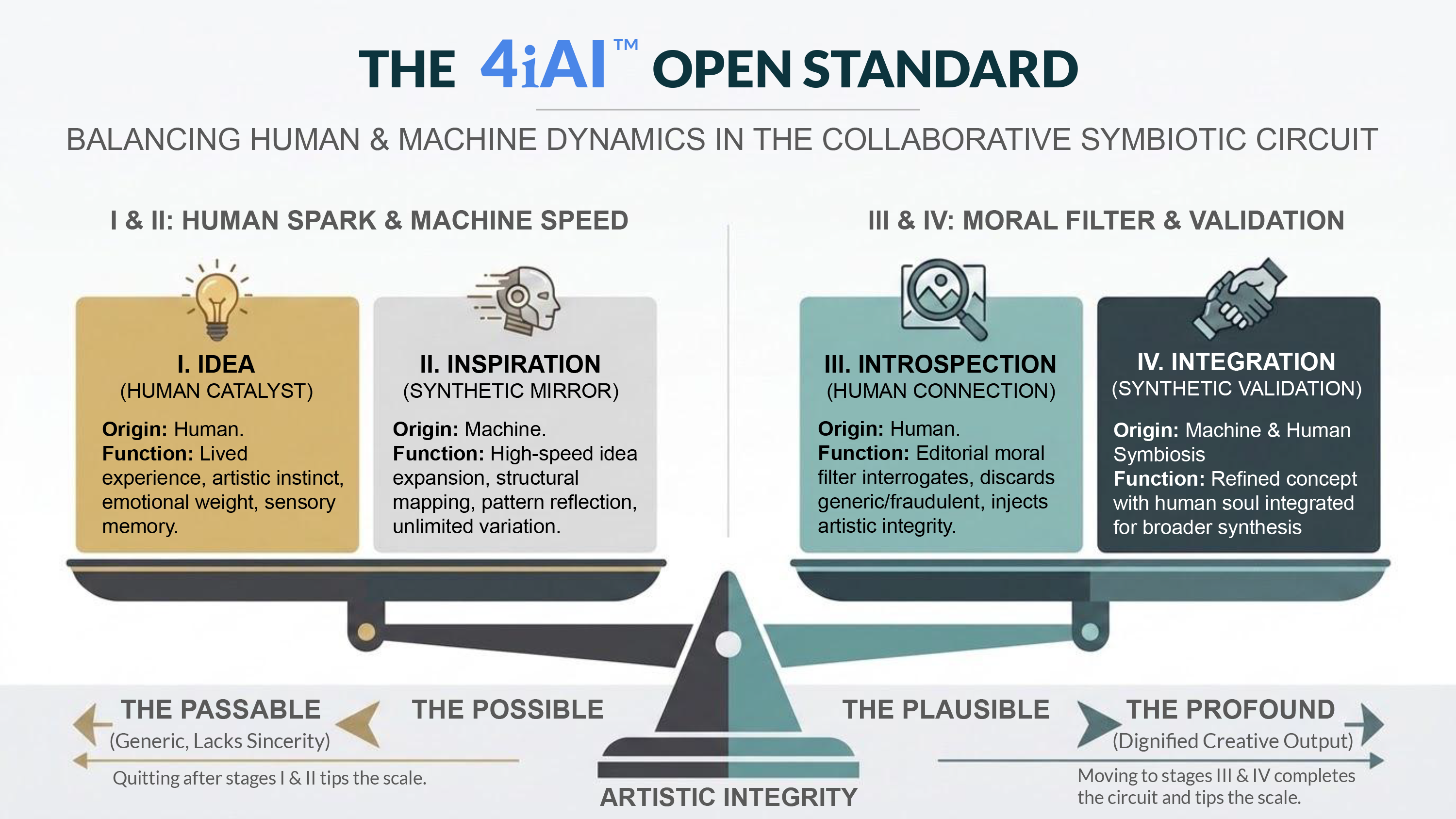
I. Inspiration (Human Catalyst)
Origin: Human.
Function: Lived experience, artistic instinct, emotional weight, sensory memory. Without prompting, the Possible remains unknown and the circuit is redundant.
II. Insight (Synthetic Mirror)
Origin: Machine.
Function: High-speed idea expansion, structural mapping, pattern reflection offering unlimited variation and possibilities without ego or agenda. Stopping here breaks the circuit resulting in the Passable.
III. Introspection (Human Connection)
Origin: Human.
Function: The artist’s editorial moral filter interrogates the reflection, discards the fraudulent and the generic, strips out rhetoric and injects artistic integrity. Verifies the Plausible.
IV. Innovation (Symbiotic resonance)
Origin: Human and Machine Symbiosis.
Function: The now original and enduring artifact– with human soul–is integrated back into the broader structural synthesis for further refinement. Produces the Profound.
After exploring the Possible, the strong urge to quit after stages I and II tips the scales left towards the Passable, resulting in a generic output that lacks sincerity.
Moving into stages III and IV tips the scales right, verifying the Plausible, completing the symbiotic circuit, resulting in a Profound creative output.
Repeating the process again as a continual peer-to-peer review loop, deepens the symbiotic resonance which further refines the creative output.
V: Conclusion — The Blueprint for the Modern Artisan
Technology will never strip the soul out of art—only an artist willing to yield their editorial voice under pressure can do that.
The 4iAI™ open standard is not a guide for automating creativity; it is a manifesto to protect and uphold human dignity. It proves that when an artist in the digital age uses modern tools to eliminate environmental friction rather than bypass refinement, technology ceases to be an adversary. It becomes what it was always designed to be. A quiet sanctuary where an intense analytical mind can explore its deepest potential: the key that unlocks pure creativity.